
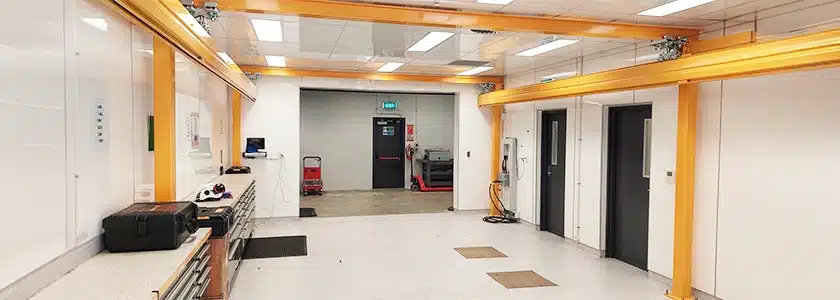
Both workstation crane systems and overhead cranes move loads overhead. Beyond that, they serve different workloads, different facilities, and different budgets. Choosing between them without understanding those differences can mean over-investing in infrastructure you don't need, or under-specifying a system that can't keep up with the job.
This guide explains how workstation crane systems and overhead cranes differ, where each performs best, and how to match the right system to your operation.
What Is a Workstation Crane System?
A workstation crane system is a modular, hollow-profile crane system designed for moving loads within a defined workspace of capacities up to 2 Tons. It can be ceiling-mounted and run on an enclosed aluminium or steel profile track, or built as a freestanding floor-supported unit, with a hoist and trolley travelling along the bridge to position loads with minimal operator effort.
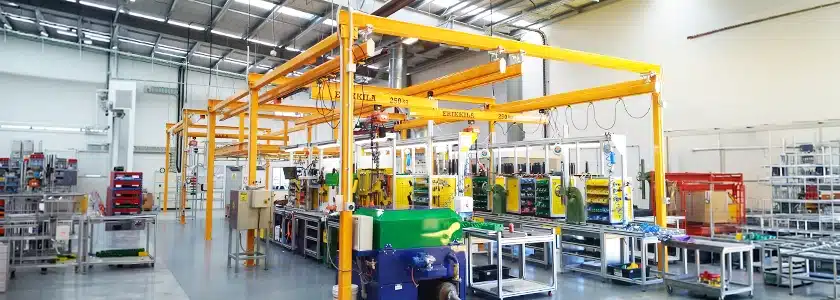
These systems come in single bridge, double bridge, and monorail configurations. Both configurations suit facilities where a conventional overhead crane runway isn't practical, whether that's because the building structure can't take the load or because the operation needs the flexibility to reconfigure or relocate the system down the track.
Stratalign's workstation crane systems cover capacities up to 2,000kg across a range of steel and aluminium profile options. For operations that need to shift the system between areas or respond to layout changes, a movable workstation crane provides that flexibility without requiring a full reinstallation.
What Is an Overhead Crane?
An overhead crane, also called a bridge crane or EOT (electric overhead travelling) gantry crane, is a heavy-duty lifting system mounted to a fixed runway structure. The runway attaches to the building's structural columns or a dedicated steel framework, with the bridge travelling along it to lift across the full span of the bay.
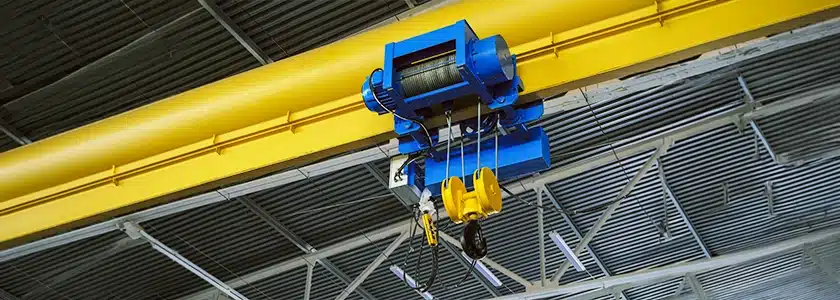
These systems come in several configurations: single girder, double girder, top running, and under running. Each suits different load capacities, hook heights, and building structures. For heavy fabrication, steel handling, and large-scale production environments, an overhead crane is built for loads that are typically 5T or more.
For an overview of how overhead cranes compare to other crane types, Stratalign's guide to choosing the right type of crane system covers the key considerations.
Comparing Workstation and Overhead Cranes
The table below covers the key differences across the factors that matter most when specifying a crane system.
| Workstation Crane System | Overhead Crane | |
| Load Capacity | Up to 2,000kg | Typically 5000kg and above |
| Coverage | Defined workspace or individual station | Full bay coverage |
| Installation | Minimal; ceiling-mounted or freestanding floor unit | Significant; requires engineered runway structure |
| Building Impact | Low: freestanding units need no structural attachment | High: runway loads must be carried by building columns or dedicated steelwork |
| Modularity | High; can be reconfigured or relocated | Low; fixed infrastructure |
| Operator Effort | Low push force; suited to ergonomic lifting | Varies by configuration and controls |
| Duty Cycle | Suited to frequent, repetitive lighter lifts | Suited to heavy lifts with appropriate rest cycles |
When Does a Workstation Crane System Make More Sense?
Workstation crane systems are often the right choice when the lifting task is repetitive, the loads are consistent, and the work happens at a defined station or along a production line. The overhead crane handles the heavy bay lifts. The workstation crane handles everything else.
A few situations where a workstation crane system is the better fit:
- The loads are sub-2,000kg and handled frequently. Overhead cranes are built for heavy, less frequent lifts. Running one all day on lighter repetitive loads is over-specifying the solution and adds unnecessary wear to a significant capital investment.
- Ergonomics matter. Workstation crane systems require very little push force to move a load horizontally. That reduces operator fatigue across a shift and lowers the risk of musculoskeletal strain, which is one of the most common causes of workplace injury in NZ manufacturing environments.
- The building can't support a runway structure. Older facilities and leased buildings often can't take the structural loads a conventional overhead crane runway requires. A freestanding workstation crane system needs only a solid concrete floor.
- The layout needs to change. Production lines get reorganised. Workstation crane systems can be reconfigured or relocated without major civil works. For operations running lean manufacturing principles, that flexibility has real value.
- The facility is leased. Making structural modifications to a building you don't own is rarely straightforward. A freestanding system avoids that problem entirely.
When Does an Overhead Crane Make More Sense?
Overhead cranes are the right choice when the loads are heavy, the lifts cover a large area, and the volume of work justifies the structural investment.
A few situations where an overhead crane is the better fit:
- The loads exceed what a Workstation crane system can safely handle. Workstation crane systems are rated to 2,000kg. If your operation regularly moves loads above that, an overhead crane is the appropriate solution.
- Full bay coverage is required. Some operations need to lift and move loads across the full width and length of a facility. A workstation crane system works within a defined area. An overhead crane, running on a fixed runway, covers the whole bay.
- The lifting frequency is high, and the loads are heavy. A workstation crane system handles frequent lighter lifts well. For operations running heavy loads repeatedly across a full production shift, an overhead crane is built for that duty cycle.
- The building is purpose-built or owned. The structural requirements for an overhead crane runway are significant. For facilities designed or modified to accommodate that infrastructure, the long-term lifting capacity justifies the investment.
What About Using Both Systems Together?
In many NZ manufacturing facilities, the answer isn't one system or the other. It's both.
A common setup we see across NZ is that an overhead crane handles heavy bay lifts, moving large fabrications or raw material stock, while workstation crane systems sit at individual stations handling the repetitive lighter lifts that happen all day. This frees the overhead crane for the work it's built for, rather[MP3.1] than tying up a significant capital asset on sub-2,000kg loads and prevents downtime of an employee waiting to use the overhead crane when it is in use elsewhere.
For operations specifying a hoist for a workstation crane system, Stratalign's electric hoist range covers the available options.
Which System Is Right for Your Operation?
The right crane system depends on what you're lifting, how often, and what your facility can support. A few decision points:
- Choose a workstation crane system if your loads are under 2,000kg, the work is repetitive, the lifting happens at defined stations, or your facility can't support a conventional runway structure.
- Choose an overhead crane if your loads regularly exceed 2,000kg, you need full bay coverage, or your facility is purpose-built to carry the structural loads a runway requires.
- Consider both if you have heavy bay lifts alongside repetitive lighter work at individual stations. That's where the two systems complement each other most effectively.
- Not Sure Which System Fits Your Operation?
Choosing between a workstation crane system and an overhead crane comes down to the specifics of your operation. Stratalign supplies both systems across New Zealand and works with manufacturers and industrial operators to match the right lifting solution to the job. Contact the Stratalign team today for an obligation-free consultation.
