
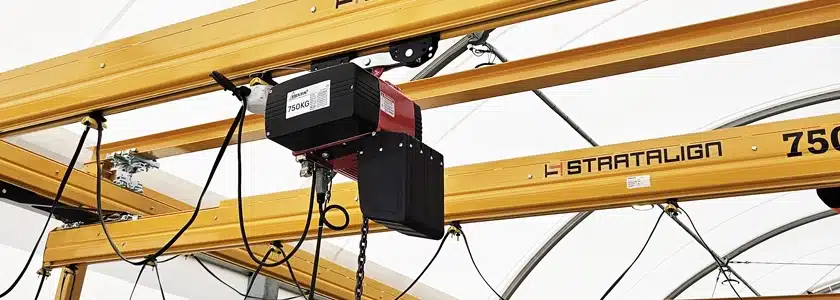
Most hoist and trolley installations don't fail during operation. They fail before the equipment arrives on site. Undersized beams, mismatched flange widths, and inadequate headroom are all avoidable problems if you catch them at the planning stage.
This guide covers the key steps to setting up an electric hoist with a trolley on an existing I-beam or monorail track: beam checks, flange width, trolley selection, clearance, and load path planning.
Step 1: Confirm Your Beam Is Rated for the Job
Confirming your beam is actually rated for the job is the step people most often skip, and it's the most important one.
Your beam needs to handle the combined weight of the hoist, the trolley, and the maximum load you plan to lift. If the beam rating is unknown or hasn't been verified, get it checked before you go any further.
Beyond the rating, look at the beam's condition. Corrosion, weld cracks, or signs of previous overloading can all affect structural integrity. Also consider span and deflection. Longer unsupported spans flex more under load, which causes uneven trolley travel and accelerates wheel wear. If your span is long relative to the beam size, a deflection check is worth doing.
Step 2: Measure the Flange Width Before You Select a Trolley
Flange width is the specification most commonly overlooked in trolley selection. Get it wrong and the trolley either won't seat properly or will sit loose enough to create a derailment risk.
Measure the bottom flange of your beam from outer edge to outer edge. Take a few measurements along the length of the beam, not just at one end. Flange width can vary slightly, particularly on older structural steel.
Match that measurement against the trolley's adjustable flange width range. Most trolleys use spacer washers to set wheel spacing, so your beam needs to fall within the specified range with enough adjustment to seat firmly.
Also, check flange thickness. Some trolleys have a maximum thickness they can accommodate, which is worth confirming if you're working with older S-beam profiles where the flange tapers toward the edges.
Step 3: Choose the Right Trolley Type
Not every application needs an electric trolley. The right drive type depends on how often loads are moved, how far they travel, and whether manual effort is practical.
- Push (plain) trolleys: are the simplest option. The operator moves the load by hand along the beam. They suit light loads, short travel distances, and infrequent lifts.
- Geared (hand chain) trolleys: use a hand chain to drive the wheels mechanically. These work better for heavier loads where pushing by hand isn't practical, or where finer control over horizontal positioning is needed.
- Electric trolleys: use a motorised drive operated by a push-button pendant. They're the right choice for production environments where lifting is frequent, travel distances are longer, or reducing operator effort is a priority. Stratalign's Balken G2 Electric Trolley and the RWM Electric Chain Hoist with Electric Trolley range are both purpose-built for industrial I-beam and monorail use.
For most NZ manufacturing and fabrication environments where lifting is part of the daily workflow, an electric trolley delivers the most consistent and safest result.
Step 4: Plan Your Headroom and Load Path
Headroom constraints that are discovered after purchase often force equipment changes or compromise usable lift height. Plan this before you order anything.
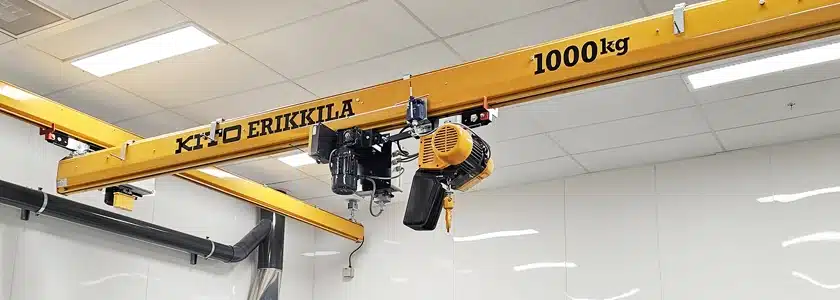
Every component between the ceiling and the hook takes up vertical space: the beam depth, the trolley height above the flange, the hoist body, the chain drop to reach the load, and any rigging below the hook. It adds up faster than expected.
If ceiling height is tight, look at integrated low-headroom configurations. These position the hoist body up between the trolley side plates rather than hanging below them, recovering a meaningful amount of vertical space.
For the load path itself, work through a few practical questions before installation:
- Travel distance: Is the beam long enough to move loads from pickup to set-down without the trolley reaching an end stop mid-travel?
- End stops: Every beam or monorail track needs physical end stops fitted at both ends. They prevent the trolley from running off the beam under load.
- Load alignment: Think about where loads will be picked up and where they need to go. Loads that swing off-centre during travel create side loading on the trolley wheels and reduce the effective capacity of the system.
Step 5: Sort Your Electrical and Control Setup
Most industrial electric hoist and trolley systems run on a 400V three-phase supply, so confirm your site supply matches the equipment specification before ordering.
From there, think through the control setup. The pendant cable needs to reach the operator at floor level when the hoist is at full height. Standard pendant cables are often too short for high-bay applications, so specify the length you need upfront. For longer monorail runs, a festoon cable system keeps things tidy by routing power to the hoist and trolley along the beam using suspended cable carriers, preventing trailing cables from snagging during travel. Plan the festoon run at the same time as the beam installation rather than retrofitting it later.
Once the control setup is sorted, confirm the circuit has a dedicated isolation point that is clearly labelled and accessible. It's a basic requirement for safe maintenance and inspection, and it's easy to get right at the installation stage.
Get the Specification Right from the Start
A well-specified hoist and trolley system is straightforward to install and reliable to operate. Most of the problems that come up on site trace back to decisions made before the equipment was ordered.
If you're planning a new hoist and trolley setup and want advice on beam compatibility, trolley selection, or system configuration, contact the Stratalign team for an obligation-free consultation.