
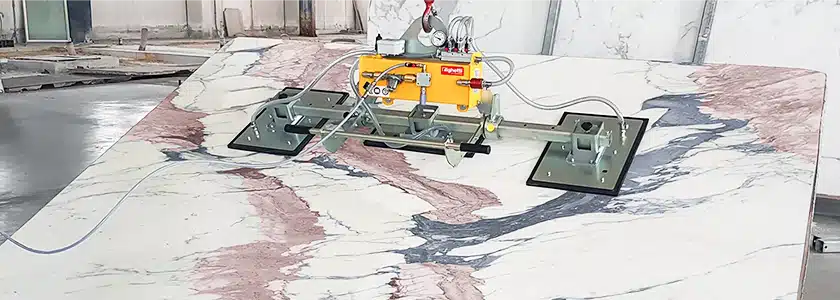
The capacity printed on a vacuum lifter assumes a clean, closed surface and full contact across every plate. Change the finish on the slab, and that figure stops applying.
A machine rated well above the slab weight can still fail to hold it. The surface decides that, and it is the part most buyers skip. This guide works through both, using the vacuum lifters Stratalign supplies for stone as the reference points.
What Makes a Slab Suitable for a Vacuum Lifter for Stone?
Two properties decide whether a seal holds, and workshops routinely treat them as one.
Porosity is breathability. A porous material lets air pass through it, so the pump works against a leak that never closes. Surface texture is a separate issue. A dense, non-porous stone with a flamed or bush-hammered face presents an uneven surface that a standard plate cannot close against, even though no air passes through the stone itself.
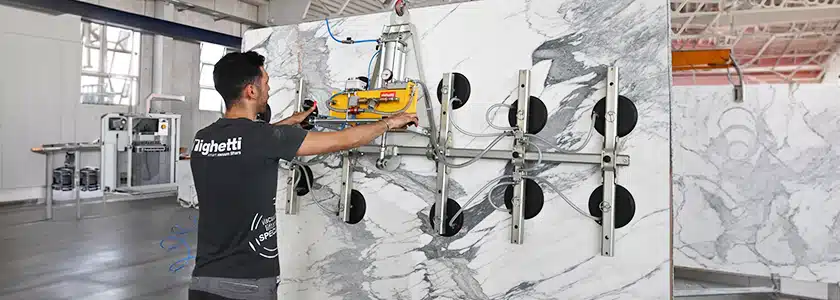
A slab can fail on either count, and the fix differs. Air passing through the material is a pump and reserve problem. Air passing under the plate edge is a seal compound problem.
Polished granite, marble, porcelain and engineered quartz seal reliably with standard plates. Honed finishes usually seal. Flamed, riven and bush-hammered finishes need a seal designed to conform to the texture. Engineered stone seals more consistently than natural stone because the surface is manufactured, so there is no variation between one slab and the next.
Inspect the slab face at the specification stage.
How Much Does a Stone Slab Actually Weigh?
Stone yards quote dimensions. Weight rarely appears on the docket, so work it out yourself before you look at any slab lifter.
Multiply length by width by thickness to get volume in cubic metres, then multiply by density. Granite runs roughly 2,650 to 2,750 kg per cubic metre. Engineered quartz runs roughly 2,350 to 2,450.
A 3,200 by 1,600 slab at 30 mm is 0.154 cubic metres. In granite, that is about 415 kg. In engineered stone, it is about 370 kg. Drop to 20 mm, and the same slab comes in at about 275 kg in granite and 245 kg in engineered stone.
Run the calculation on your heaviest regular slab. Then add margin for what you expect to be handling in three years, because capacity is the one specification you cannot upgrade later.
How Do You Match Slab Weight to Lifter Capacity?
Suction plate size sets capacity. A stone vacuum lifter listed at 2,000 kg reaches that figure only with the largest plates fitted, so compare the band.
| Product Code | Capacity Band | Suction Plates | Power Source |
|---|---|---|---|
| M1B | 100 kg to 1,000 kg | Single plate | Onboard rechargeable battery |
| M3A | 375 kg to 2,000 kg | Three plates, in-line | Compressed air |
| M3EB | 375 kg to 2,000 kg | Three plates, in-line | Electric, 220V single phase or 400V three phase |
Power source usually follows the site. The M1B stone vacuum lifter suits yards and sites without fixed services. The M3A keeps batteries and electrical supply off the lifter entirely where a shop already runs an air line. The M3EB suits fixed workshop installation.
Take the 415 kg granite slab above. It sits inside the M1B band and inside the M3 band, but whether either machine lifts it depends on the plate configuration fitted. Ask that question at specification.
Precast concrete and tilt panels sit outside this range. Forklift-mounted lifters with multiple plates and powered tilt handle panel work, and our guide to vacuum lifters in construction covers the difference.
How Do Surface Finishes Change Plate Selection?
Plate size drives capacity. Seal compound drives whether the grip survives the finish. Those are two separate decisions, and most NZ benchtop shops need both answered because the same machine handles imported engineered stone and locally supplied natural stone through the week.
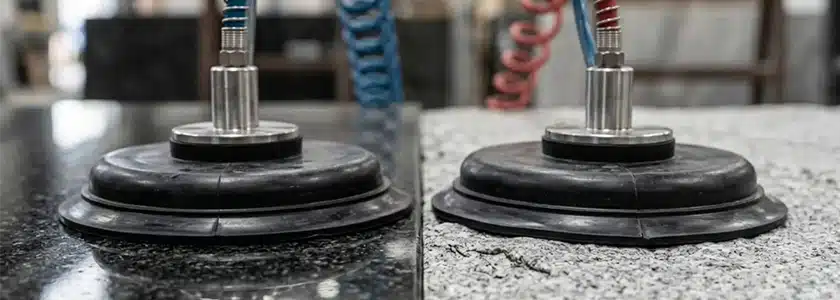
A granite vacuum lifter running polished slabs only needs one plate set. Add flamed exterior cladding to the mix, and you need a seal that copes with both surfaces, or a second set.
Stone processing runs wet and dusty by design, so all three M-series units carry filtration against dust and condensation, and the M3EB includes a purge tap for clearing the vacuum tank. Put plate inspection and tank purging into the weekly maintenance round.
Handling Slabs with Cutouts and Small Offcuts
Both M3 models let you isolate plates individually. Shut off the side plates to lift small offcuts on the centre plate alone. Shut off the centre plate to lift a slab with a sink cutout through the middle, where a fixed three-plate arrangement would have nothing to grip.
In a benchtop shop, that flexibility earns its keep more often than raw capacity does.
What Safety Systems Should Vacuum Lifting Equipment Have?
Stone is brittle. A dropped slab is scrap, and the people working beneath it are the real concern.
Vacuum lifting equipment handling stone should carry an audio-visual alarm that warns the operator before vacuum drops into unsafe territory, and a vacuum gauge with a coloured scale the operator can read at a glance. All three M-series units include both.
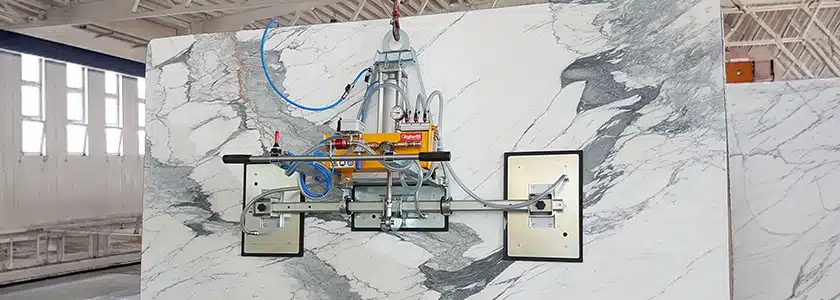
Controlled/power tilting through 0 to 90 degrees is the other control worth specifying. Moving slabs between A-frame storage and a horizontal saw bed is the most repeated task in a stone yard, and controlled tilt keeps the load flat and the stone unstressed through the transfer.
Getting the Specification Right for Your Workshop
Four answers get you to the right machine. Your heaviest regular slab in kilograms. The range of finishes you handle. The power available where the lifter will work. Whether you need to tilt.
Bring those to us, and we will confirm the plate configuration and capacity to match. Book a consultation, and we will work through it with you.
