
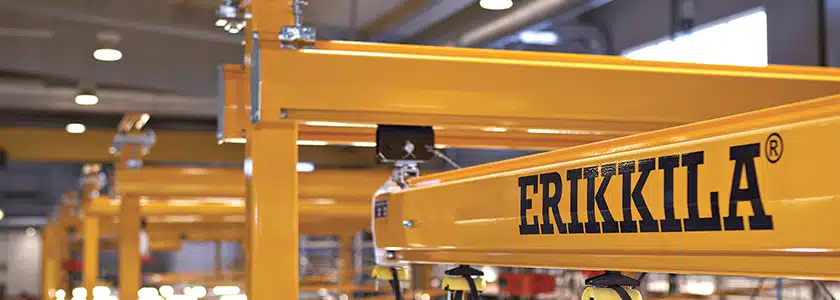
Light cranes, otherwise known as hollow profile cranes, are designed to move loads of up to two tonnes. But the term ‘light crane’ covers a wide array of material handling equipment. So how do you ensure that you’re choosing the right light crane for your situation?
In this guide we’ll look at what a light crane is, when you’d use one, and the different factors to consider when choosing from light crane types.
Understanding light cranes (hollow profile)
The term ‘light crane’ can be used for almost any crane designed to lift light-to-medium loads (up to two tonnes), but it is most commonly used to describe hollow profile cranes.
These light crane systems form an alternative to heavy-duty I-beam cranes. “Hollow profile” is exactly as it sounds: the beams of these cranes are hollow, and the bridge trolley and hoist (whether electric, manual, chain or lever) rolls within them.
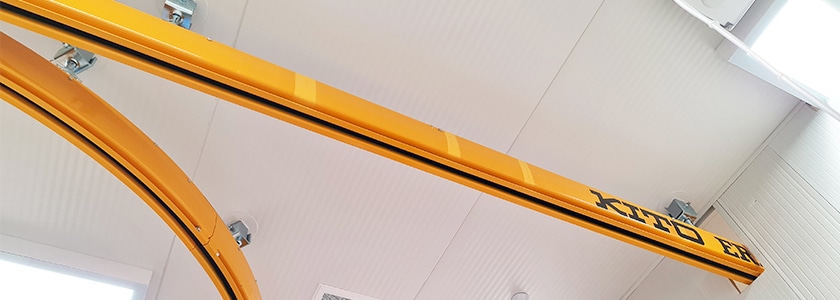
The hollow beams may be light, but they actually provide the highest strength-to-weight ratio of any crane system in the world. They are a popular option for localised lifting over a specific workstation or work zone, but are also light and easy to move.
When should you use a light crane?
With the trolley travelling within the hollow profile of the beam, a light crane system offers a number of unique benefits:
Very low rolling resistance
Featuring smooth rolling nylon wheels with sealed bearings, applying a force that is 1% of load weight will move that load – i.e. a one tonne load will require just 10kg of pushing force.
Ease of use
This low rolling resistance makes light crane systems very easy to use, and the ideal option for situations in which workers are conducting consistent, repetitive lifts, such as in factories or on production/assembly lines.
Lower maintenance
Unlike I-beam systems, which feature an exposed trolley, hollow profile cranes fully encapsulate the trolley. This minimises dust and debris and can reduce the cleaning and maintenance needs of the beam and trolley significantly.
Factors to consider when choosing the right light crane
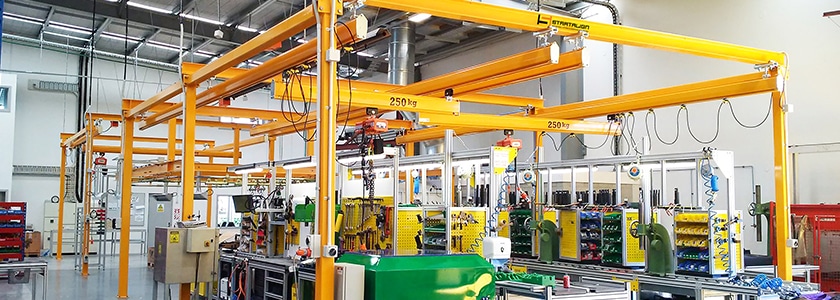
How do you choose the right light crane for your situation? Consider the following factors:
- Load capacity: How heavy are the loads that you need to lift and shift?
- Span and footprint: How much distance do you need loads to cover? Light cranes can cover a square footprint (workstation cranes), or they can run in a line to link different areas of a site together (monorail cranes).
- Lift height: Consider the dimensions of each load you’ll need to handle and the height of your ceiling.
- Duty cycle: How often will you need to use the crane, and how close to the load capacity will each load get?
- Environment: The protection that the hollow profile beams offer trolleys make light cranes a good option for dusty, dirty, debris-filled environments. But you should also choose a crane built from materials that can handle any excessive heat, moisture and exposure to the elements that they might encounter.
- Customisation: At Stratalign we offer modular, fully customisable light crane systems that can be adapted to your specific needs, wants, situation and limitations.
Helping New Zealand manufacturers safely solve their lifting challenges with the best local and global solutions
At Stratalign we’ve spent years helping Kiwi businesses identify and secure the lifting equipment they need. Our team has the knowledge and expertise you need to identify the ideal light crane type for your situation – the system that will make your business safer, more efficient and more productive.
We offer a complete range of light cranes, all of which are certified to AS 1418.1.
