
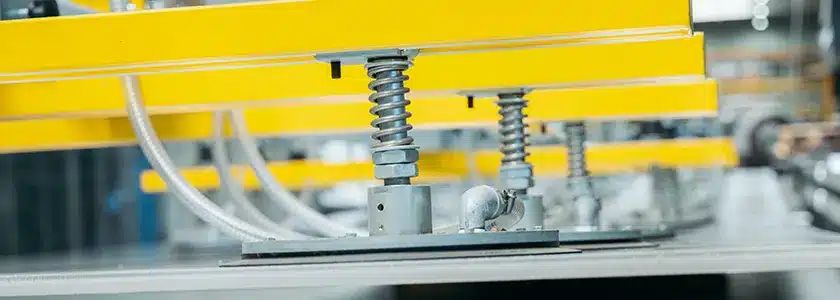
From heavy steel sheets to delicate glass panels, vacuum lifters take the hard work out of material handling. They’re a go-to tool across industries like manufacturing, construction, and logistics because they combine strength with precision, lifting loads safely, efficiently, and with minimal effort.
But how does a vacuum lifter work behind the scenes? In this guide, we’ll unpack the core components, explain the science of vacuum lifting, explore the different types available, and walk through the step-by-step process.
The Core Components of a Vacuum Lifter
A vacuum lifter might look straightforward from the outside, but under the hood, every component is designed with safety and reliability in mind. Each part works together to create a system that can securely lift heavy or fragile loads with precision. Here are the essentials:
- Vacuum Pump or Generator: The engine of the system, removing air to create suction. Depending on the setup, this can be powered electrically or by compressed air.
- Suction Pads or Cups: The connection point with the load. Pads form an airtight seal, with different designs for different jobs; flat pads for glass or metal, and bellows pads for textured or uneven surfaces.
- Lift Beam or Frame: The backbone of the lifter, distributing weight evenly and providing structural strength.
- Control System: The operator’s interface, whether manual or powered, ensures smooth engagement, lifting, moving, and release of the load.
- Safety Features: Built-in protections such as non-return valves, gauges, and alarms. Many models also include backup vacuum reservoirs to keep the load secure in case of power loss.
Together, these parts form a well-balanced lifting system that minimises operator effort, protects materials, and ensures a consistent, controlled workflow.
Understanding the Science Behind Vacuum Lifting
The principle behind vacuum lifting is surprisingly simple: it uses atmospheric pressure to do the heavy work. When air is removed from inside the suction cup, the pressure inside drops below the surrounding atmospheric pressure. This process creates a strong downward force that holds the material securely to the lifter.
The effectiveness depends on two main factors:
- Surface Area: Larger suction pads or multiple pads spread across a load can generate more grip.
- Seal Integrity: Smooth, non-porous surfaces (like glass or sheet metal) are ideal because they allow an airtight seal.
This combination of physics and smart engineering turns vacuum lifters into an excellent tool for lifting equipment optimisation, reducing the need for manual handling and improving consistency.
Types of Vacuum Lifters and How They Work
Not all vacuum lifters are built the same. While they share the same basic principle, using suction to create a secure grip, each type works differently and is designed for specific environments or lifting challenges. Here are the most common options :
Compressed Air Vacuum Lifters
These systems use a venturi effect powered by compressed air to generate suction. Compressed air vacuum lifters are simple, robust, and well-suited to workshop or factory settings where air supply is readily available.
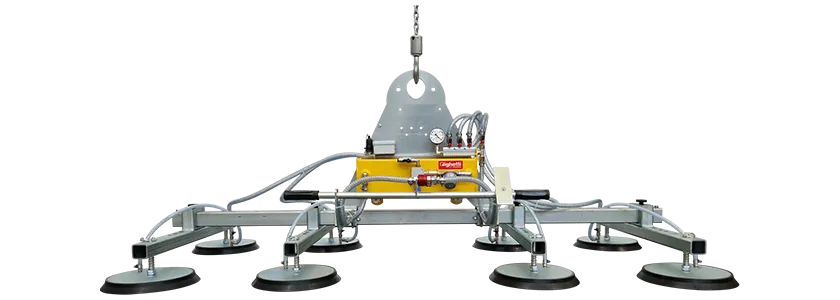
Because they don’t rely on electricity or batteries, they’re low-maintenance and a good choice for heavy-duty, continuous lifting in industrial environments.
Mechanical Vacuum Lifters
Mechanical lifters don’t need any external power source. Instead, the vacuum is created through the movement of the lifting equipment itself, typically as the lifter is raised or lowered.
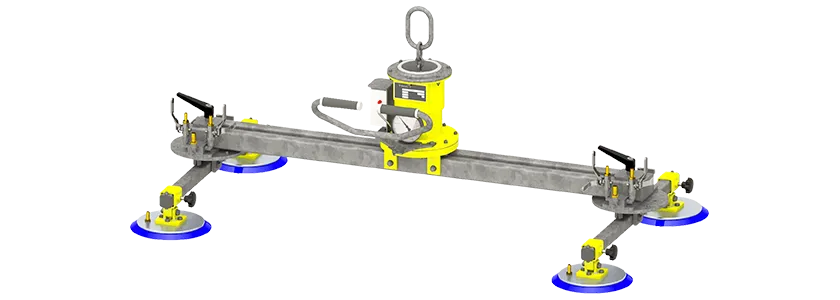
This function makes them reliable, quiet, and ideal for repetitive handling tasks where simplicity and independence from utilities are an advantage.
Electric-Powered Vacuum Lifters
Electric lifters run on mains power and use an onboard electric pump to generate vacuum pressure. They’re highly consistent, making them ideal for heavy-duty lifting where stable, continuous suction is required.
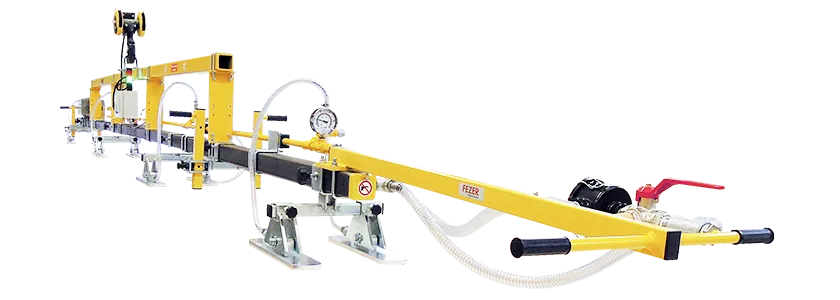
Their reliability and higher capacity make them a strong fit for manufacturing environments where maximum uptime and precision are critical.
Battery-Powered Vacuum Lifters
These cordless systems use rechargeable batteries to power vacuum generation. The big advantage is mobility; they’re not tied to an air line or electrical connection.
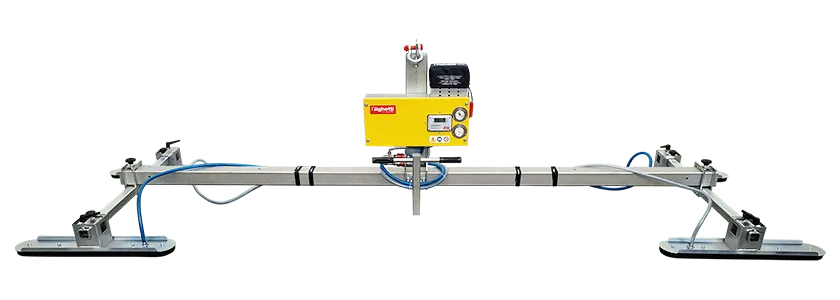
This makes battery vacuum lifters well-suited for sites where loads are moved across multiple zones, outdoors, or in locations without reliable utility access.
How a Vacuum Lifter Operates: Step by Step
The process of using a vacuum lifter is straightforward but precise:
- Positioning: The operator aligns the suction pads over the load.
- Engaging the Vacuum: The pump or generator is activated, creating suction that forms an airtight seal.
- Monitoring: Gauges or indicators confirm that the vacuum pressure is at safe levels.
- Lifting: The load is raised using the crane, hoist, or jib system supporting the lifter.
- Transporting: The load is moved into position with smooth, controlled movement.
- Releasing: The vacuum is disengaged, allowing air back into the pad and releasing the load safely.
Each stage is designed to reduce manual effort, protect workers, and ensure consistent handling across multiple lifts.
The Right Lifter for the Job
Vacuum lifters change the way businesses handle materials. By using air pressure to create suction, these systems make it easier and safer to move heavy, fragile, or awkward loads.
Beyond lifting, the real value lies in improved productivity, reduced strain, and safer workplaces. If you’re ready to optimise your lifting processes, Stratalign can help match the right vacuum lifter to your operation.
